
| > | restart;
|
Exercice 1
question a)
| > | taille:=proc(A) supposons A de taille n*p
local t,u,n,p; t:=[op(2,evalm(A))]; renvoi [1..n,1..p] n:=op(2,t[1]);p:=op(2,t[2]); [n,p]; end: |
| > | question b) |
| > | En notant A=(a(ij));B=(b(ij));AB=(c(ij)); |


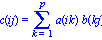
| > | On a c(ij)=Sum(a(ik)*b(kj),k=1..p); |
| > | produit:=proc(A,B)
local k,C,n,p,q,i,j,t; t:=taille(A); n:=t[1]; p:=t[2]; t:=taille(B); q:=t[2]; if (t[1]<>p) then RETURN(IMPOSSIBLE); fi; C:=array(1..n,1..q); for i from 1 to n do for j from 1 to q do C[i,j]:=add(A[i,k]*B[k,j],k=1..p); od; od; RETURN(evalm(C)); end: |
| > | question c) |
| > | MatPermut:=proc(i,j,n)
local k,l,P; P:=array(1..n,1..n); for k from 1 to n do k est l'indice de ligne for l from 1 to n do l est l'indice de colonne P[k,l]:=0; tous les coefficients de la ligne k sont nulls od; P[k,k]:=1; sauf celui d'indice k od; On a a obtenu jusqu'ici la matrice identité P[i,i]:=0;P[j,j]:=0;P[i,j]:=1;P[j,i]:=1; On modifie 4 de ses coefficients evalm(P); end: |
| > | P:=MatPermut(1,3,3);A:=array(1..3,1..3,[[a1,b1,c1],[a2,b2,c2],[a3,b3,c3]]); |
![P := matrix([[0, 0, 1], [0, 1, 0], [1, 0, 0]])](images/exo1_5.gif)
![A := matrix([[a1, b1, c1], [a2, b2, c2], [a3, b3, c3]])](images/exo1_6.gif)
| > | PA:=produit(P,A); |
![PA := matrix([[a3, b3, c3], [a2, b2, c2], [a1, b1, c1]])](images/exo1_7.gif)
| > | AP:=produit(A,P); |
![AP := matrix([[c1, b1, a1], [c2, b2, a2], [c3, b3, a3]])](images/exo1_8.gif)
Conclusion: le produit par la matrice de permutation, correspond ŕ la permutation des lignes lorqu'elle est le facteur de gauche, ou la permutation des colonnes lorqu'elle est le facteur de droite
| > |
| > | question d) |
| > | MatDilat:=proc(a,j,n)
local k,l,P; P:=array(1..n,1..n); for k from 1 to n do for l from 1 to n do P[k,l]:=0; od; P[k,k]:=1; od; On a a obtenu jusqu'ici la matrice identité P[j,j]:=a; On modifie un coefficient evalm(P); end: |
| > | Di:=MatDilat(x,2,3);
DA:=produit(Di,A); |
![Di := matrix([[1, 0, 0], [0, x, 0], [0, 0, 1]])](images/exo1_9.gif)
![DA := matrix([[a1, b1, c1], [x*a2, x*b2, x*c2], [a3, b3, c3]])](images/exo1_10.gif)
| > | AD:=produit(A,Di); |
![AD := matrix([[a1, b1*x, c1], [a2, x*b2, c2], [a3, b3*x, c3]])](images/exo1_11.gif)
| > | Conclusion: le produit par la matrice de dilatation, correspond ŕ la dilatation des lignes lorqu'elle est le facteur de gauche, ou la dilatation des colonnes lorqu'elle est le facteur de droite |
| > | question e) |
| > | MatTransvect:=proc(i,a,j,n)
local k,l,P; P:=array(1..n,1..n); for k from 1 to n do for l from 1 to n do P[k,l]:=0; od; P[k,k]:=1; od; On a a obtenu jusqu'ici la matrice identité P[i,j]:=a; On modifie un coefficient evalm(P); end: |
| > | T:=MatTransvect(3,x,2,3);
TA:=produit(T,A); |
![T := matrix([[1, 0, 0], [0, 1, 0], [0, x, 1]])](images/exo1_12.gif)
![TA := matrix([[a1, b1, c1], [a2, b2, c2], [x*a2+a3, x*b2+b3, x*c2+c3]])](images/exo1_13.gif)
| > | AT:=produit(A,T); |
![AT := matrix([[a1, b1+c1*x, c1], [a2, b2+x*c2, c2], [a3, b3+c3*x, c3]])](images/exo1_14.gif)
| > | Conclusion: le produit par la matrice de transvection, correspond ŕ la transvection des lignes lorqu'elle est le facteur de gauche, ou la transvection des colonnes lorqu'elle est le facteur de droite |