![A = matrix([[2, 3, 4, 5], [3, 4, 5, 6], [4, 5, 6, 7]])](images/exo3_1.gif)
| > | restart;
|
| > |
| > | Exercice 3 |
| > | question a) |
| > | A:=array(1..3,1..4): for i from 1 to 3 do for j from 1 to 4 do A[i,j]:=i+j: od:od: |
| > | A=evalm(A); |
| > | A1:=Dilat_ligne(1/2,1,A); L2 <-- L2/2 |
![A1 := matrix([[1, 3/2, 2, 5/2], [3, 4, 5, 6], [4, 5, 6, 7]])](images/exo3_2.gif)
| > | A2:=Transvect_ligne(2,-3,1,A1); L2 <-- L2- 3*L1 |
![A2 := matrix([[1, 3/2, 2, 5/2], [0, (-1)/2, -1, (-3)/2], [4, 5, 6, 7]])](images/exo3_3.gif)
A3:=Transvect_ligne(3,-4,1,A2); L3 <-- L3- 4*L1
![A3 := matrix([[1, 3/2, 2, 5/2], [0, (-1)/2, -1, (-3)/2], [0, -1, -2, -3]])](images/exo3_4.gif)
| > | question b) |
| > | Gauss1:=proc(A)
local t,B,k; t:=taille(A); B:=array(1..t[1],1..t[2]); B:=evalm(A); B contient une copie exact de A, mais B est modifiable contrairement à A B:=Dilat_ligne(1/B[1,1],1,B); L1 <--1/a(11) *L1 for k from 2 to t[1] do B:=Transvect_ligne(k,-B[k,1],1,B); Lk <-- Lk- a(k1)*L1 od; evalm(B); end: |
| > | Gauss1(A); On retrouve comme prévu: |
![matrix([[1, 3/2, 2, 5/2], [0, (-1)/2, -1, (-3)/2], [0, -1, -2, -3]])](images/exo3_5.gif)
| > |
| > |
| > | question c) |
| > | zero_sous_pivot:=proc(i,A)
local t,B,k; t:=taille(A); B:=array(1..t[1],1..t[2]); B:=evalm(A); B contient une copie exact de A, mais B est modifiable contrairement à A la procédure ne marche que si l'indice i ne dépasse pas la taille de la matrice et le pivot a(ii) est NON NUL if is(i>t[2]) or is(i>t[1]) or is(B[i,i]=0) then RETURN(IMPOSSIBLE); fi; B:=Dilat_ligne(1/B[i,i],i,B); Li <--1/a(ii) *Li for k from i+1 to t[1] do k parcourt les indice de ligne en dessous du pivot B:=Transvect_ligne(k,-B[k,i],i,B); Lk <-- Lk- a(ki)*Li od; evalm(B); end: |
| > |
| > | question d) |
| > | Gauss_systeme:=proc(A)
local T,i,j,t; t:=taille(A); T:=array(1..t[1],1..t[2]); T:=evalm(A); T contient une copie exact de A, mais T est modifiable contrairement à A for j from 1 to min(t[1],t[2]) do on parcourt les éléments de la diagonale d'indice jj i:=CherchePivot_colonne(T,j); On cherche un pivot non nul dans la colonne j if i<>0 then T:=Permut_ligne(i,j,T); Au cas où l'on trouve ce pivot, on permute avec la ligne actuel et on annule les coefficients sous celui-ci T:=zero_sous_pivot(j,T); fi; sinon on passe à la colonne suivante od; evalm(T); end: |
| > |
| > | question e) |
| > | B:=array(1..4,1..5): for i from 1 to 4 do for j from 1 to 5 do B[i,j]:=i+j: od:od: |
| > | B=evalm(B); |
![B = matrix([[2, 3, 4, 5, 6], [3, 4, 5, 6, 7], [4, 5, 6, 7, 8], [5, 6, 7, 8, 9]])](images/exo3_6.gif)
| > | Gauss_systeme(B); |
![matrix([[1, 3/2, 2, 5/2, 3], [0, 1, 2, 3, 4], [0, 0, 0, 0, 0], [0, 0, 0, 0, 0]])](images/exo3_7.gif)
Ainsi, puisque les deux dernières équations sont compatibles, il ne nous reste plus qu'à étudier le système
| > | x+3*y/2+2*z+5*t/2=3; y+2*z+3*t=4; |
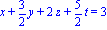

où les inconnues z et t jouent le rôle de paramètres