
Exercice 10
| > | restart; |
| > | rho:=theta->1+2*cos(theta)-4*cos(theta)^2; |
Domaine d'Etude
On réduit l'intervalle d'étude à -Pi..Pi par périodicité
#Puis à 0..Pi car
| > | rho(-theta)=rho(theta); |

| > | evalb(%); |

#Le support complet se déduit alors par symétrie par rapport à l'axe des abscisses
Points caractéristiques
Intersection avec l'axe des abscisses
| > | assume(t>=0 and t<=Pi); |
| > | r:=[solve(rho(t)=0,t)]; |
![r := [Pi-arccos(1/4*5^(1/2)-1/4), 1/5*Pi]](images/ex10_4.gif)
| > |
| > |
| > |
| > |
| > | r:=[solve(rho(t)/sin(t)=0,t)]; |

| > | r:=simplify(r); |
![r := [arctan((10-2*5^(1/2))^(1/2)/(5^(1/2)+1)), -arctan((10-2*5^(1/2))^(1/2)/(5^(1/2)+1)), -arctan((10+2*5^(1/2))^(1/2)/(-1+5^(1/2)))+Pi, arctan((10+2*5^(1/2))^(1/2)/(-1+5^(1/2)))-Pi]](images/ex10_6.gif)
| > | t_0:=0:M(t_0)=[rho(t_0)*cos(t_0),rho(t_0)*sin(t_0)],'rho'(t_0)=rho(t_0); |
![M(0) = [-1, 0], rho(0) = -1](images/ex10_7.gif)
| > | t_0:=Pi/3:M(t_0)=[rho(t_0)*cos(t_0),rho(t_0)*sin(t_0)],'rho'(t_0)=rho(t_0); |
![M(1/3*Pi) = [1/2, 1/2*3^(1/2)], rho(1/3*Pi) = 1](images/ex10_8.gif)
| > | t_0:=2*Pi/3:M(t_0)=[rho(t_0)*cos(t_0),rho(t_0)*sin(t_0)],'rho'(t_0)=rho(t_0); |
![M(2/3*Pi) = [1/2, -1/2*3^(1/2)], rho(2/3*Pi) = -1](images/ex10_9.gif)
| > | t_0:=Pi:M(t_0)=[rho(t_0)*cos(t_0),rho(t_0)*sin(t_0)],'rho'(t_0)=rho(t_0); |
![M(Pi) = [5, 0], rho(Pi) = -5](images/ex10_10.gif)
| > |
Calcul de la direction de la tangente
Dérivée de la paramétrisation
| > | Drho:=D(rho); |

| > | cV:=Drho(theta)/rho(theta); |
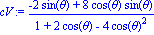
cotan V
| > | cV:=simplify(cV); |
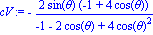
| > | V:=unapply(arccot(cV),theta); |
On en déduit V modulo Pi

D'où quelques tangentes particulières
| > | t_0:=0:'V'(t_0)=V(t_0); |

| > | t_0:=Pi/3:'V'(t_0)=V(t_0); |

| > | t_0:=Pi:'V'(t_0)=V(t_0); |

Variations de rho et de V
| > | plot(rho,0..Pi); |
![[Plot]](images/ex10_18.gif)
| > | plot(V,0..Pi); |
![[Plot]](images/ex10_19.gif)
Support de Courbe
| > | total:=[rho(t),t,t=-Pi..Pi]:partiel:=[rho(t),t,t=0..Pi]: |
| > | plot([total,partiel],-1..5,-2..2,color=[red,blue],thickness=[3,3],coords=polar); |
![[Plot]](images/ex10_20.gif)
| > |