
| > | Exercice 15 |
| > | Question a) |
| > | f:=x->x^2*exp(-2*x); |
D'oł la courbe est au dessus de son asymptote y=x+1/6
| > | plot([f(x),0],x=-0.8..3,color=[red,blue],thickness=[2,1],discont=true); |
![[Plot]](images/exo15_2.gif)
| > | Question b) |
| > | f:=x->(x^3-1)^2; |

| > | plot([f(x),0],x=-5..5,color=[red,blue],thickness=[2,1],discont=true); |
![[Plot]](images/exo15_4.gif)
| > | Question c) |
| > | f:=x->sqrt(x^2+3*x+1); |

| > | f(x)=series(f(x),x=infinity,2);f(x)=series(f(x),x=-infinity,2); |

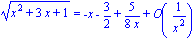
f est en dessous de son asymptote y=x+3/2 en +infini et en dessous de y=-x-3/2 en -infini
| > | plot([f(x),x+3/2,-x-3/2],x=-8..8,0..10,color=[red,blue,green],thickness=[2,1,1],discont=true); |
![[Plot]](images/exo15_8.gif)
| > | Question d) |
| > | f:=x->x^2*ln(abs((x+1)/x)); |

| > | f(x)=series(f(x),x=infinity,4);f(x)=series(f(x),x=-infinity,4); |


| > | f est au dessus de son asymptote y=x-1/2 en +infini et en dessous de celle-ci en -infini |
| > | Limit(f(x),x=-1)=limit(f(x),x=-1); |

D'oł une asymptote verticale x=-1
| > | plot([f(x),x-1/2],x=-5..5,-5..5,color=[red,blue],thickness=[2,1],discont=true); |
![[Plot]](images/exo15_13.gif)
| > | Question e) |
| > | f:=x->x^3/(1-2*x^2); |

| > | f(x)=series(f(x),x=infinity,3);f(x)=series(f(x),x=-infinity,3); |


| > | f est en dessous de son asymptote y=-x/2 en +infini et au dessus de celle-ci en -infini |
Il y a de pkus deux asymptotes verticales x=1/racine(2) et x=-1/racine(2)
| > | plot([f(x),-x/2],x=1..5,color=[red,blue],thickness=[2,1],discont=true); |
![[Plot]](images/exo15_17.gif)
| > |