



| > | restart;with(plots):with(plottools):with(linalg); |
Warning, the name changecoords has been redefined
Warning, the assigned name arrow now has a global binding
Warning, the protected names norm and trace have been redefined and unprotected
| > |
Exercice 2
question g)
| > | f:=(x,y)->(x*y)/(x+y); |

| > | Limit('f'(x,0), x=0)=limit(f(x,0),x=0); |

| > | Limit('f'(x,-x+x^2), x=0)=limit(f(x,x^2-x),x=0); |
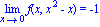
Les limites suivants les courbes y=0 et y=x^2-x différent, il n'y a donc pas de limite globale
Profil suivant y=0
| > | coupe(f,[-0.1,1],[-1,1],[t,0],[-1,1],-y,-0.1,100); |
![[Plot]](images/exo2g_8.gif)
| > | coupe_plan(f,[t,0],[-1,1]); courbe t->f(t,0) |
![[Plot]](images/exo2g_9.gif)
Profil suivant y=x^2-x
| > | coupe(f,[-1,1],[-1,1],[t,-t+t^2],[-1,1],-y+x^2-x,-10^9,100); |
![[Plot]](images/exo2g_10.gif)
| > | coupe_plan(f,[t,-t+t^2],[-1,1]); courbe t->f(t,-t+t^2) |
![[Plot]](images/exo2g_11.gif)
Représentation
| > | coupe(f,[-1,1],[-1,1],[t,-t+t^2],[-0.5,1],1,-0.1,50); |
![[Plot]](images/exo2g_12.gif)
| > | profilx:=theta->t;profilx:=theta->(1-theta)*0+theta*(-t+t^2);t='t': |


Voici l'évolution de la route tracée sur la surface lorsque le trcé plan passe de la droite y=x à la courbe y=x^3
| > | profil_courbe(f,profilx,profily,[-0.5,1],[0,1],-5); |
![[Plot]](images/exo2g_15.gif)
| > | F:=proc(theta) coupe_plan(f,[profilx(theta),profily(theta)],[-0.5,1]); end: |
| > | animate(F,[theta],theta=0..1, axes=normal,frames=41); |
![[Plot]](images/exo2g_16.gif)
| > |