



| > | restart;with(plots):with(plottools):with(linalg); |
Warning, the name changecoords has been redefined
Warning, the assigned name arrow now has a global binding
Warning, the protected names norm and trace have been redefined and unprotected
| > |
Exercice 5
question d)
| > | f:=(x,y)->piecewise(x=0 and y=0, 0,(x*sin(y)-y*sin(x))/(x^2+y^2)); |

| > | sin(t)=series(sin(t),t=0,3); |

| > | donc sin(t)=t+t^2*epsilon(t); |

| > | avec Limit(epsilon(t),t=0)=0; |

| > | et donc 'f'(x,y)=expand((x*(y+y^2*epsilon(y))-y*(x+x^2*epsilon(x)))/(x^2+y^2)); |
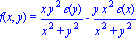
| > | Or abs(xy^2/(x^2+y^2)) <= abs(x); |

Donc par le thérorème des gendarmes
| > | Limit( x*y^2*epsilon(y)/(x^2+y^2),[x,y]=0)=0; |
![Limit(x*y^2*epsilon(y)/(x^2+y^2), [x, y] = 0) = 0](images/exo5d_11.gif)
D'où f est continue en (0,0) et de facon claire en tout autre point
| > | plot3d(f(x,y),x=-1..1,y=-1..1,axes=normal); |
![[Plot]](images/exo5d_12.gif)
| > | Voici le profil de la section obtenu par une droite passant par l'origine et tournant au cours du temps |
| > | profil_x:=theta->cos(theta)*t;profil_y:=theta->sin(theta)*t;t:='t': |


| > | sect:=theta->cos(theta)*x+y*sin(theta); |

| > | profil_courbe(f,profil_x,profil_y,[-5,5],[-Pi,Pi],0); |
![[Plot]](images/exo5d_16.gif)
Le même profil vu sur un plan fixe (courbe du paramétrage)
| > | F:=proc(theta) plot(f(profil_x(theta),profil_y(theta)),t=-5..5 ); end: |
| > | animate(F,[theta],theta=-Pi..Pi, axes=normal,frames=41); |
![[Plot]](images/exo5d_17.gif)
Voici les courpes obtenues par les sections correspondantes à ces droites tournantes
| > | profil_section(f,[-5,5],[-5,5],sect,[-Pi,Pi],-10); |
![[Plot]](images/exo5d_18.gif)
| > |